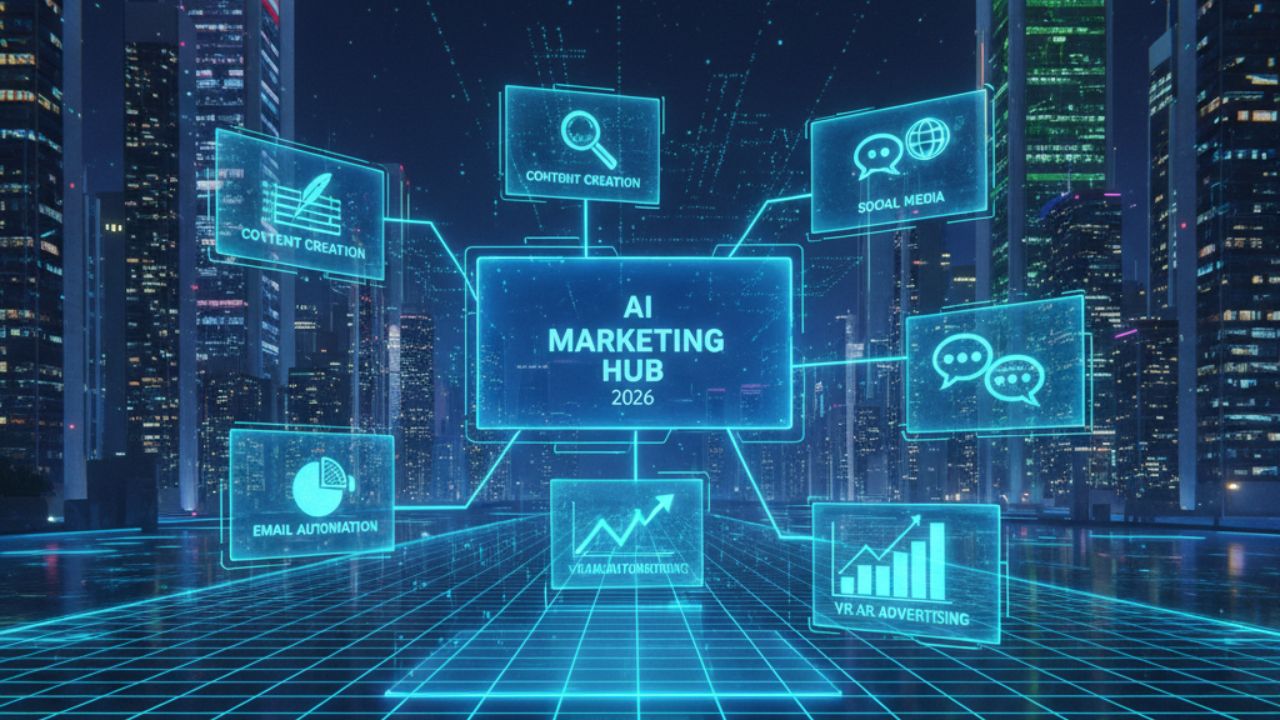
Artificial intelligence is no longer just a buzzword. It’s the engine driving the entire digital marketing vehicle. We have moved past the experimental phase where businesses dipped their toes into automation. By 2026, AI is fully integrated into the workflow of every successful marketing agency and in-house team. The question isn’t if you should use AI, but which tools will give you the competitive edge.
The landscape is vast and often overwhelming. New platforms launch daily, promising to revolutionize how we work. However, specific tools have risen to the top, proving their worth through reliability, innovation, and measurable ROI. This is particularly true in massive markets like the United States and Brazil, where digital consumption is at an all-time high.
In this guide, we will navigate the current state of the industry and break down the essential AI tools you need in your tech stack this year. Whether you are a solo creator in New York or managing a large-scale agency in São Paulo, these are the platforms that will define your success.
The Digital Marketing Landscape in 2026: A Tale of Two Giants
The United States and Brazil represent two of the most dynamic digital economies in the Western Hemisphere. While they share similarities in terms of heavy social media usage and mobile-first consumers, 2026 has brought distinct characteristics to each market.
United States: Precision and Privacy
In the U.S., the focus has shifted heavily toward hyper-personalization balanced with strict data privacy. With regulatory scrutiny at an all-time high, American marketers are turning to AI tools that can deliver 1:1 experiences without compromising user trust. The market here demands sophisticated automation that feels human. Generic “spray and pray” tactics are extinct; AI is now used to predict consumer needs before the consumer even articulates them.
Brazil: Engagement and Conversation
Brazil remains a powerhouse of social engagement. In 2026, it continues to lead the world in time spent on social platforms. The Brazilian market is characterized by conversational commerce. Tools that facilitate instant interaction—via WhatsApp, Instagram Direct, and voice interfaces—are crucial. AI in Brazil isn’t just about data; it’s about maintaining a 24/7 conversation with a highly communicative audience. The integration of AI into messaging apps has become the standard for customer service and sales.
Top AI Tools for Content Creation
Content remains king, but the kingdom has expanded. Marketers are under pressure to produce high-quality assets at an unprecedented scale. These tools are the leaders in generating text, images, and video.
Jasper (The Strategist’s Choice)
Jasper has evolved significantly. By 2026, it is no longer just a writing assistant; it is a full-fledged content strategist. It understands brand voice better than most freelancers.
- Best feature: The “Brand Voice Memory” allows it to scan your website and mimic your exact tone across emails, blogs, and ads.
- Why it wins: It integrates seamlessly with SurferSEO and Grammarly, making it a comprehensive workspace.
Midjourney v7 (Visual Excellence)
For graphic assets, Midjourney remains the gold standard for artistic generation. The v7 update has virtually eliminated the “uncanny valley” effect. It creates photorealistic marketing assets that would previously require expensive photoshoots.
- Best feature: The “Style Reference” capability allows brands to upload a mood board, ensuring all generated images adhere to strict brand guidelines.
- Market fit: Extremely popular in creative-heavy Brazilian agencies for campaign visualization.
HeyGen (Video at Scale)
Video content is non-negotiable. HeyGen allows marketers to create professional spokesperson videos without a camera crew. You simply type the script, choose an avatar (or your own digital twin), and the AI generates a lip-synced video in minutes.
- Best feature: Instant translation. You can record a video in English and have HeyGen translate it into Portuguese with perfect lip-syncing, making it essential for cross-border campaigns between the USA and Brazil.
Top AI Tools for SEO
Search Engine Optimization in 2026 is less about keywords and more about user intent and topical authority. Search engines are smarter, and your tools need to be too.
SurferSEO (Content Intelligence)
SurferSEO continues to dominate on-page optimization. It analyzes the top-ranking pages for your target query and provides a data-driven blueprint for your content.
- Evolution: It now includes an “Intent Analyzer” that predicts whether a user wants to buy, learn, or browse, helping you structure your content accordingly.
Ahrefs AI (The Technical Powerhouse)
Ahrefs has integrated deep learning into its site audit and keyword explorer tools. It creates clusters of topics automatically, saving SEOs hours of manual mapping.
- Best feature: The “Opportunity Detector” scans your competitors’ declines in traffic and suggests immediate actions to capture their lost market share.
Can I Rank? (Predictive SEO)
This tool uses AI to answer the specific question: “Can I rank for this keyword?” It gathers data from successful websites and compares it to your site’s metrics, giving you a probability score and actionable steps to improve it.
Top AI Tools for Social Media Management
Managing multiple channels requires more than just scheduling. It requires active listening and intelligent engagement.
FeedHive (The Content Recycler)
FeedHive uses AI to analyze your best-performing posts and suggests the best times to repost or repurpose them. It takes the guesswork out of vitality.
- Best feature: Its AI-generated hashtags and conditional posting logic (e.g., “If this post gets 100 likes on Twitter, post it to LinkedIn”) make it incredibly powerful for automation.
ManyChat (Conversational Commerce)
Crucial for the Brazilian market, ManyChat automates conversations on Instagram and WhatsApp.
- 2026 Update: It now includes “Sentiment Routing.” The AI detects if a customer is angry or frustrated and automatically routes the chat to a human agent, while handling routine queries (like tracking orders) without human intervention.
Lately (The Repurposing Engine)
Lately is an AI tool that learns what your audience wants to read, hear, or watch, and then creates content to match. It can ingest a long-form blog post or a podcast episode and slice it into dozens of high-performing social media posts.
Top AI Tools for Data Analytics and Reporting
Data is useless if you can’t interpret it. These tools turn spreadsheets into stories.
Polymer (The Data Visualizer)
Polymer uses AI to turn spreadsheets into interactive databases. You don’t need to be a data scientist to use it. You upload your data, and its AI instantly suggests the most insightful visualizations.
- Use case: Marketing managers use this to present campaign results to stakeholders without needing complex BI tools.
Pecan AI (Predictive Analytics)
Pecan brings predictive modeling to the masses. It connects to your CRM and ad platforms to predict future outcomes, such as customer churn or lifetime value (LTV), weeks in advance.
- Strategic value: Instead of reporting on what happened, Pecan tells you what will happen, allowing you to adjust budgets proactively.
How to Choose the Right AI Tools for Your Business
With thousands of options available, selecting the right stack is critical. Here is a framework for making the right choice:
- Define the Bottleneck: Don’t buy a tool just because it’s trendy. Identify where your team is slowing down. Is it writing copy? Is it analyzing data? Is it customer support?
- Integration Capability: In 2026, siloed tools are productivity killers. Ensure the AI tool integrates with your existing CRM (like HubSpot or Salesforce) and project management software.
- Language Support: For businesses operating in both the USA and Brazil, native language support is vital. Does the tool understand Portuguese idioms as well as it understands American English slang?
- Scalability: Can the tool handle the volume of data you expect to have in two years? AI tools often price based on usage credits; ensure the pricing model works as you scale.
- Compliance: Ensure the tool adheres to GDPR (if you have European traffic), LGPD (Brazil), and CCPA (California).
Case Studies: Successful Implementation of AI
USA: The E-commerce Giant
A mid-sized clothing retailer based in Chicago struggled with cart abandonment. Their email sequences were generic and ignored.
- The Solution: They implemented Klaviyo’s AI features to predict the exact time a user was most likely to open an email. They also used Jasper to personalize the subject lines based on the user’s browsing history.
- The Result: Open rates increased by 40%, and revenue from recovered carts jumped by 22% within three months.
Brazil: The Fintech Startup
A São Paulo-based fintech company was overwhelmed by customer service tickets on WhatsApp. Their response time was averaging 4 hours, causing user churn.
- The Solution: They integrated ManyChat powered by a custom-trained GPT-4 model. The bot could handle Tier 1 support queries (balance checks, password resets) in Portuguese.
- The Result: Response time dropped to under 10 seconds. Human agents were freed up to handle complex financial disputes, and customer satisfaction scores (CSAT) rose by 35%.
Future Trends in AI and Digital Marketing
As we look toward the latter half of the decade, three trends are becoming clear:
1. The Rise of “Agentic” AI
We are moving from AI that assists to AI that acts. Soon, you won’t just ask an AI to write an email; you will give it a goal (e.g., “Increase leads by 10% this month”), and a network of AI agents will autonomously write ads, adjust bids, and send emails to achieve that goal, requiring human approval only at key milestones.
2. Voice Search Optimization 2.0
With the explosion of smart home devices in US households and the reliance on voice notes in Brazil, optimizing for spoken queries is paramount. AI tools will focus heavily on “conversational SEO”—optimizing for natural language questions rather than short keywords.
3. Hyper-localized Content
AI will enable massive localization. A global brand will be able to produce thousands of variations of an ad, not just translating the language, but adjusting cultural references, visual backgrounds, and even the ethnicity of the models in the images to match the specific demographic of a city or neighborhood.
Embracing AI for Digital Marketing Success
The divide between businesses that use AI and those that don’t is widening into a chasm. In 2026, utilizing these tools is not about cutting corners; it is about amplifying human creativity and strategic thinking.
For marketers in the USA and Brazil, the opportunities are boundless. The tools listed above—from Jasper’s content generation to Pecan’s predictive analytics—are the weapons of choice for the modern digital warrior. The key is not to fear the technology, but to master it. Start by auditing your current workflow, identify the friction points, and implement the right AI solution today. The future of marketing isn’t coming; it’s already here.